



The Sermon on the Crumb: When the Ant Became the Theologian of the Universe
The ants have finally produced their Michelangelo.
After four hundred million years of perfecting tunnels, pheromones, and the quiet socialism of the colony, one worker has broken rank, climbed the highest crumb in the anthill, and opened a book the size of a billboard. The moment is so absurd it loops back around into sanctity.
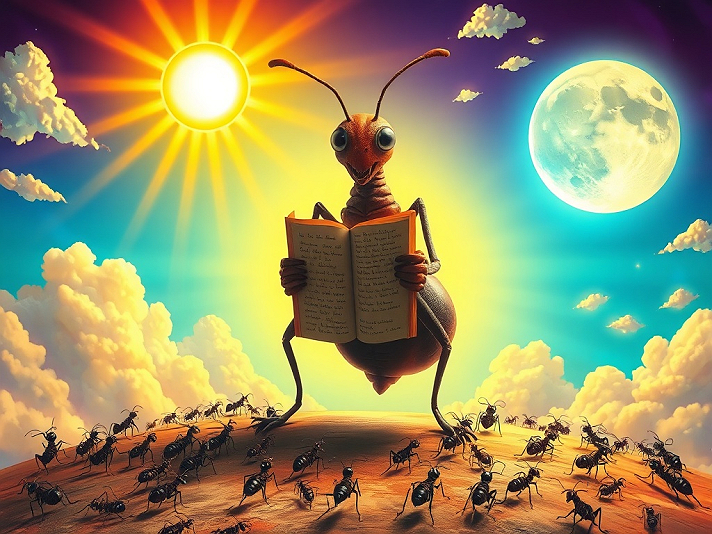
Look at the proportions: the preacher-ant stands no taller than a dandelion stem, yet the sun and moon have shrunk to polite spotlights hovering at shoulder height, as if the entire solar system RSVP’d to a backyard sermon. The sky itself has been demoted to a soft pastel backdrop suitable for children’s wallpaper. This is not the cosmos bowing to humanity; this is the cosmos being gently asked to sit down and behave while the real drama happens at ground level, six millimeters above the dirt.
The book is the first miracle. It is bound in golden leather that no aphid ever secreted, its pages thick as cathedral doors yet weightless enough for chitin forelegs to hold without trembling. The script inside is not ant glyphs, not chemical trails, not the frantic dance of scouts reporting nectar two centimeters east-southeast. It is human handwriting (spidery, looping, unmistakably the pen of a Victorian schoolgirl practicing copperplate). The text itself is legible if you squint: fragments of Psalm 19, a grocery list, half a love letter that ends mid-sentence with “I think of you every time the rain.” The absurdity is deliberate. The Word was never waiting for the right species; it was waiting for the right attention span, and today an ant has outlasted every doctoral committee.
The congregation is the second miracle. Ten thousand workers have abandoned their posts. No one is carrying, no one is digging, no one is milking aphids. They stand in perfect concentric rings, antennae raised like tiny periscopes, every faceted eye reflecting the preacher’s glowing thorax. This is the first recorded instance of ants experiencing awe. Evolutionary biologists will weep when they see the photograph; theologians will weep harder. The same creatures that once dismembered caterpillars without malice have suddenly discovered posture, stillness, and the concept of up.
Notice the light. It does not fall on the ant; it rises from the ant. The sun is redundant. The moon is a night-light for people who still need training wheels. The true source is the open page itself, emitting a honey-colored radiance that turns every grain of sand into a pixel of stained glass. This is what Scripture always meant by “lighter than vanity”: a single verse outweighs galaxies when someone finally reads it aloud in a language that has no word for tomorrow.
The preacher’s expression is the third and funniest miracle. Ants do not have eyebrows, yet this one has managed to raise something equivalent. The mandibles are parted in what can only be called a grin of pure delight, as if the entire revelation has boiled down to one cosmic punchline and the ant just got it. The joke, of course, is scale. The same God who carved the Grand Canyon with a glacier spent an afternoon teaching a creature the size of a punctuation mark how to read. Omnipotence has a sense of humor after all.
Somewhere in the back row, a single larva (still pale, still legless) is being held aloft by nurses so it can see. That larva will never forage, never mate, never even harden into an adult. Its entire life will be spent as a living bookmark, carried from page to page by the colony that now understands itself as a library. Every ant that dies will be buried with a crumb of the preached word pressed to its mandible like a communion wafer. The hill will become a scriptorium. Future archaeologists will find fossils with microscopic letters etched into their head capsules: verses too small for human eyes, preserved perfectly for sixty million years.
And the sermon itself? No one will ever record it. Ants have no ears, only substrate vibration, so the preacher is preaching through foot-drumming, a Morse code of revelation tapped directly into the ground. The message travels at the speed of dirt, rippling outward in perfect circles until it reaches the queen three chambers down. She pauses mid-egg-laying, feels the rhythm, and for the first time in her twenty-year reign lays an egg that glows faintly gold. The colony will never be the same. They will still farm fungi, still wage war on termites, but every action will now carry the aftertaste of meaning.
This is the final joke: the meek have inherited the earth, and they are six-legged, weigh half a milligram, and consider a dropped pretzel crumb to be a continent. While humans were busy building cathedrals and particle colliders, the ants quietly achieved what centuries of theology only theorized. They produced a preacher who needs no microphone, a congregation that never checks its phone, and a scripture that fits on the head of a pin yet outweighs the moon.
The sun and moon hang in the sky like embarrassed chaperones who showed up overdressed to a party where the real celebration is happening under a pebble. They will keep shining, of course; someone has to provide reading light for creatures too small to cast shadows. But from this day forward, every dawn will be slightly apologetic, every night a little sheepish, because the true light of the world has been relocated to an anthill behind the compost bin, where a single worker is still preaching, still grinning, still holding the book upside-down because orientation is a human anxiety and the Word, apparently, reads the same in every direction.
And if you lie down at dusk with your ear to the ground, you can hear it: the faintest tap-tap-tap, steady as a heartbeat, carrying across backyards and continents. It is the sound of the smallest preacher in the universe refusing to stop, because some revelations are too important to finish before the heat death of the sun, and anyway, the congregation has nowhere else to be.
They have all the time in the world.
They have six legs, compound eyes, and a love letter written in ballpoint pen that somehow fits every creature that ever crawled.
Tap.
Tap.
Tap.
The sermon continues.
The cosmos, for once, is listening.